Key facts
- The Temple menorah had seven branches and was lit every day in the Temple in Jerusalem.
- The Hanukkah menorah, or hanukkiah, has eight lights plus a shamash, nine in all, and is lit on the eight nights of Hanukkah.
- Menorah is the Hebrew word for lamp. Hanukkiah is the modern Hebrew name for the Hanukkah lamp.
- Hanukkah marks the rededication of the Second Temple after the Maccabees' victory, in about 164 BCE.
- The seven-branched menorah is the emblem of the State of Israel.
What is the difference between a menorah and a hanukkiah?
A menorah, in its original sense, is the seven-branched golden lamp of the Temple. A hanukkiah is the nine-light lamp used on Hanukkah: eight lights for the eight nights and a shamash to light them. In English both are usually called a menorah; in Israel the Hanukkah lamp is almost always called a hanukkiah.
| Feature | Temple menorah | Hanukkah menorah (hanukkiah) |
|---|---|---|
| Lights | 7 | 8 plus the shamash |
| Where it was lit | The Tabernacle and the Temple in Jerusalem | Every Jewish home |
| When | Every day, by the priests | The eight nights of Hanukkah |
| Fuel | Pure olive oil | Oil or candles |
| Source | Exodus 25:31-40 | Talmud, Shabbat 21b-23a |
The word hanukkiah came into use in modern Hebrew. Older sources speak of the ner Hanukkah, the Hanukkah light, or the menorat Hanukkah, the Hanukkah lamp, which is why menorah is a perfectly good word for it in English.
Is it Hanukkah or Chanukah?
Both. The Hebrew word חנוכה begins with the letter chet, a throaty sound English has no letter for, so it is written with an H or with Ch. Hanukkah, Chanukah and Chanukkah are all common, and none is more correct than the others. The same goes for hanukkiah, also written chanukiah.
We use Hanukkah and hanukkiah on our English pages because they are the spellings most people search for.
What was the Temple menorah?
The Temple menorah was a seven-branched lamp hammered from a single block of pure gold, described in Exodus 25:31-40. It stood in the Tabernacle in the desert and later in the Temple in Jerusalem, and the priests lit its lamps with pure olive oil every day.
After the Romans destroyed the Second Temple in 70 CE, they carried the menorah to Rome, a scene still carved on the Arch of Titus. The Talmud teaches that one should not make an exact copy of the Temple menorah (Rosh Hashanah 24a).
What is the story of Hanukkah?
In the second century BCE the Seleucid Greek king Antiochus IV outlawed Jewish practice and defiled the Temple. A revolt led by Mattathias the priest and his son Judah the Maccabee won back Jerusalem, and on 25 Kislev, in about 164 BCE, they cleansed the Temple and dedicated it again. Hanukkah means dedication.
The First Book of Maccabees (4:52-59) records the eight days of dedication and the decision to celebrate them every year. The prayer Al HaNissim, added to the prayers and grace after meals on Hanukkah, gives thanks for delivering "the many into the hands of the few".
Why is Hanukkah eight nights?
The Talmud (Shabbat 21b) tells that when the Hasmoneans entered the Temple they found only one jar of pure oil still sealed by the High Priest, enough to light the menorah for a single day. It burned for eight days, until new pure oil could be prepared, and the following year those eight days were fixed as a festival.
The Second Book of Maccabees (10:6) adds another reason: the eight days were celebrated like the festival of Sukkot, which the fighters had been unable to keep that autumn. The same page of the Talmud records that the School of Shammai lit eight lights on the first night and fewer each night after, while the School of Hillel began with one and added one each night. The law follows Hillel.
What is the shamash for?
Shamash means attendant. The Hanukkah lights are holy and may only be looked at, not used for reading or any other purpose, so a ninth light is added: it lights the others and gives the useful light in the room. It stands apart from the eight, higher or to one side, so you can still count the night's lights (Shulchan Aruch, Orach Chaim 673:1).
How to light the Hanukkah menorah
Why is the menorah a symbol of the Jewish people?
The seven-branched menorah is one of the oldest Jewish symbols, carved on ancient synagogues and tombs and on the Arch of Titus in Rome. In 1949 the State of Israel chose it, between two olive branches, as its national emblem. For many Jews it stands for light, for endurance, and for the Temple.
The prophet Isaiah's call to be "a light unto the nations" (Isaiah 42:6) is often linked to it, and the hanukkiah carries the same idea into every home: its lights are placed where people passing by can see them.
Which of our pieces carry the menorah symbol?
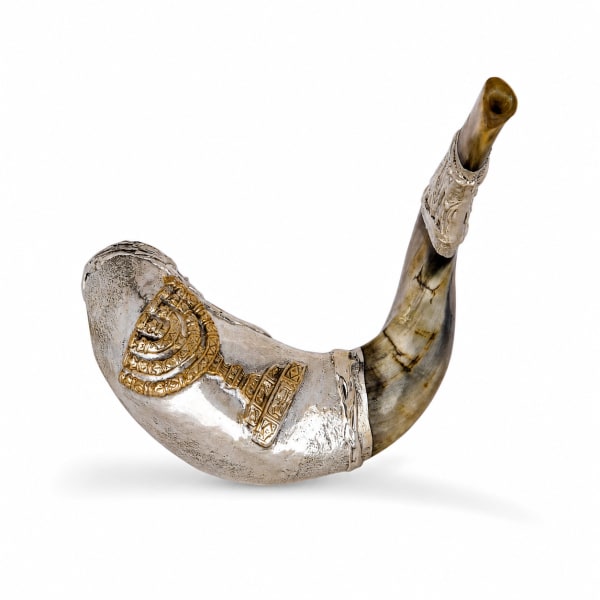
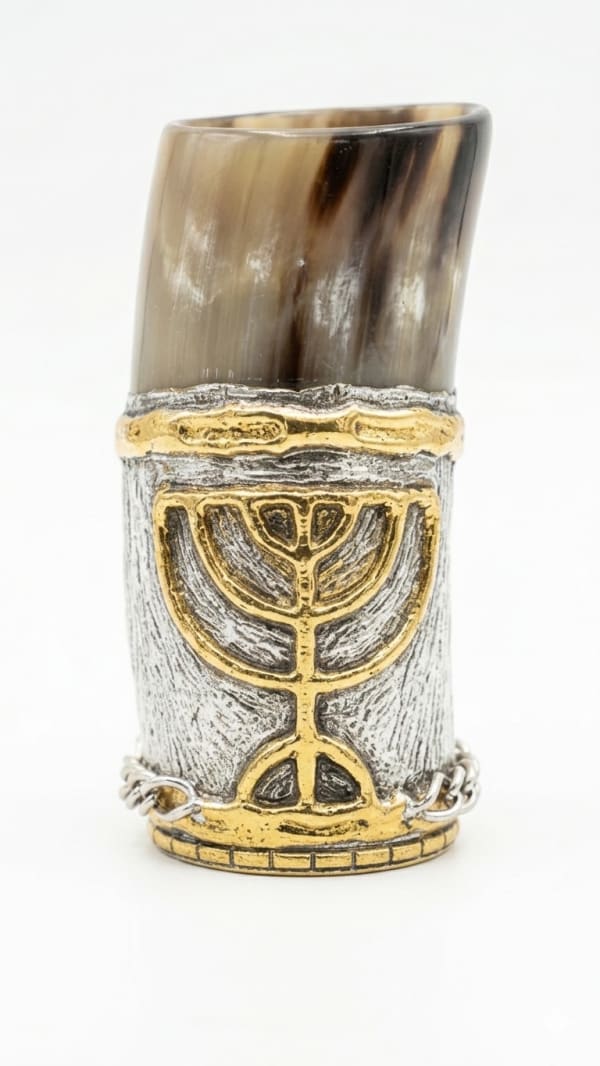
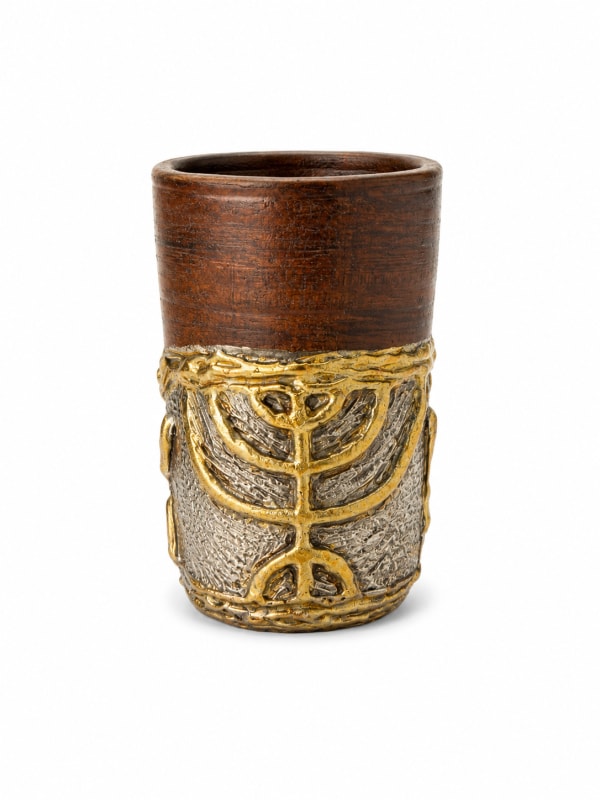
Several of our pieces carry the seven-branched menorah: kudu and ram's horn shofars plated in 925 silver and decorated with a menorah, a kudu shofar with the lions of Jerusalem and a menorah, the Menorah Goblet, a ram's horn wine goblet with a menorah encircling the cup, and a ceramic Kiddush cup with a 925 silver-plated rim.
Kudu shofar with a menorahRam's horn shofar with a menorahKudu shofar with the lions of Jerusalem and a menorahThe Menorah GobletCeramic Kiddush cup with a menorah
For lighting at Hanukkah itself, our hanukkiot are made of double-sided handmade glass in three shapes, Half-Moon, Rectangular and Trapezoid, in eight colors.
Handmade glass Hanukkah menorahsHow to choose a Hanukkah menorah